Etre comme on le désire tout simplement, grâce à la chirurgie & la médecine esthétique en Tunisie avec MEDHANNIBAL.
The Modern Gentleman’s Guide to Facial Rejuvenation: Facelifts & Eyebrow Transplants (2026 Edition)
In 2026, the stigma surrounding male aesthetic surgery has vanished. Driven by « Zoom fatigue, » a competitive corporate landscape, and the desire to match one’s physical appearance with their internal energy, men are seeking procedures that offer subtlety, structure, and strength.
Unlike female aesthetics, which often prioritize softness and curves, male facial rejuvenation focuses on angularity, a sharp jawline, and « invisible » scars that don’t interfere with beard growth. This guide explores the two most transformative procedures for the modern man: the Facelift and the Eyebrow Transplant.
The Male Facelift (Rhytidectomy)
1. Anatomy: Why Men are Different
A surgeon cannot treat a man’s face like a woman’s. There are three critical anatomical differences:
- Skin Thickness: Men have thicker, more vascular skin due to testosterone. This means a higher risk of hematoma (bruising) but often better structural support.
- Hair-Bearing Skin: The position of the sideburns and the beard line is sacred. A poorly executed facelift can pull beard hair into or behind the ear, making shaving difficult and the surgery obvious.
- Ligament Strength: Male facial ligaments are generally tougher, requiring more precise release during surgery to achieve a natural lift.
2. The Gold Standard: The Deep Plane Facelift
In 2026, the « Skin-only » lift is obsolete. For men, the Deep Plane Facelift is the preferred method.
- The Technique: Instead of pulling the skin (which creates the « wind-tunnel » look), the surgeon goes beneath the SMAS (Superficial Musculoaponeurotic System) layer. They release the tension on the deep ligaments and reposition the entire composite of muscle and fat.
- The Result: A sharp, masculine jawline and a lifted mid-face without the « tight » appearance.
- The Advantage: Because the skin isn’t under tension, scars heal significantly better—crucial for men with short hair.
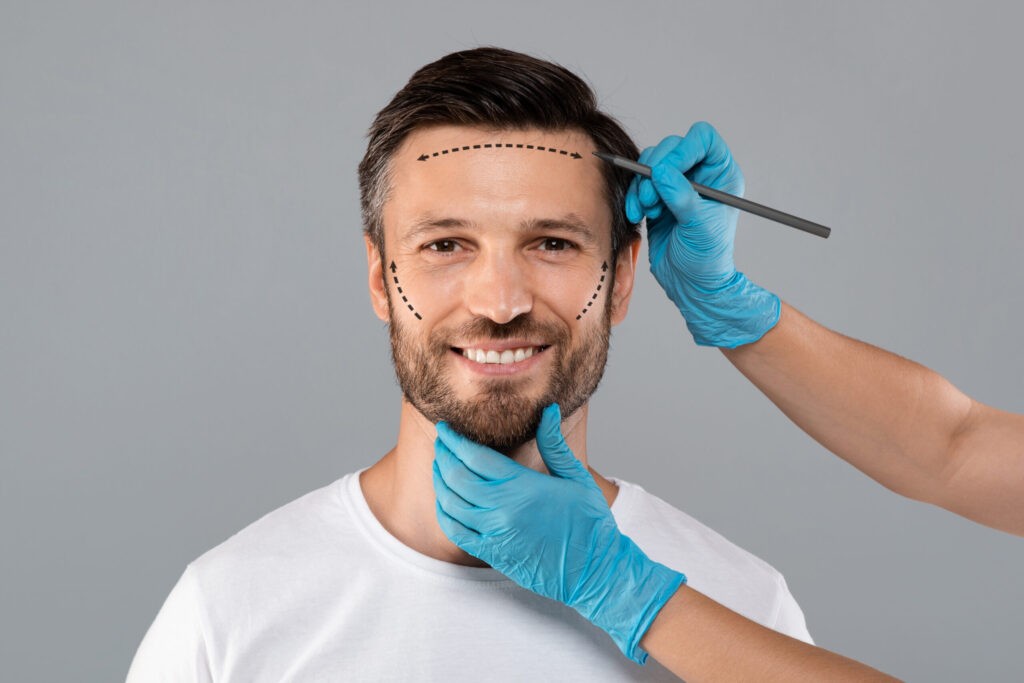
3. Managing the « Turkey Neck »
For many men, the primary concern is the « Turkey Neck » or the loss of the cervicomental angle (the L-shape under the chin).
- Platysmaplastie: The surgeon sutures the two edges of the platysma muscle together (like a corset) to eliminate vertical bands.
- Submandibular Gland Reduction: Sometimes, the « fullness » under a man’s jaw isn’t just fat; it’s an enlarged salivary gland. Modern male facelifts often involve reducing these glands for a truly chiseled look.
Eyebrow Transplantation (FUE)
While the facelift restores the lower two-thirds of the face, the eyebrows define the « upper-third » authority. Thinning brows are a major sign of aging in men, often caused by genetics or « brow ptosis » (sagging).
1. The Masculine Brow Architecture
A man’s eyebrow differs from a woman’s in three ways:
- Shape: Men’s brows are typically flatter and lower on the orbital rim. A high arch looks feminine and « surprised » on a man.
- Density: Men require higher density, especially in the « head » (inner part) of the brow.
- Texture: The hair is often coarser.
2. The Procedure: FUE (Follicular Unit Extraction)
The most advanced method is FUE, where individual hair follicles are harvested from the back of the scalp (the donor area) and transplanted to the brow.
- The « Angle » is Everything: Hair on the eyebrow grows at a very acute angle to the skin (almost flat). The surgeon must create « incisions » at a 10-15 degree angle to ensure the hair doesn’t stick straight out.
- Directional Mapping: Brow hair changes direction—pointing up at the nose, horizontally in the middle, and down at the tail. A 5,000-word level of expertise requires a surgeon who maps these 300-500 grafts individually.
3. Maintenance Post-Transplant
Since the hair comes from the scalp, it will continue to grow at the rate of scalp hair.
- Trimming: Men must be prepared to trim their « new » eyebrows every 7–10 days.
- Training: Using a brow gel for the first few months helps « train » the hair to lie flat against the skin.
Synergy – Why Combine Them?
Combining a facelift with an eyebrow transplant (often performed with a blepharoplasty or eyelid lift) creates a Total Facial Harmony.
- The « Resting Grump » Face: A sagging brow combined with jowls makes a man look angry or tired.
- The Solution: By lifting the structural foundation (Facelift) and restoring the frame of the eyes (Brows), the patient looks « refreshed » rather than « operated on. »
The Surgical Journey (Preparation & Consultation)
1. Choosing the Surgeon
For a male facelift, look for:
- A portfolio with at least 30% male patients.
- Specific expertise in Deep Plane techniques.
- An understanding of the « Beard-Ear » interface.
2. Pre-Op Requirements
- Smoking: Must stop 4 weeks before and after. Smoking is the #1 cause of skin necrosis (skin death) in facelifts due to restricted blood flow.
- Supplements: Avoid Fish Oil, Vitamin E, and Aspirin (blood thinners).
- Beard Prep: Most surgeons ask you to grow 2-3 days of stubble so they can see the natural hair direction during the marking phase.
Recovery and Long-Term Care (The First 30 Days)
| Timeline | Facelift Recovery | Eyebrow Transplant Recovery |
|---|---|---|
| Days 1-3 | Compression bandage, mild swelling, « tight » sensation. | Tiny scabs at graft sites. Do NOT touch. |
| Days 7-10 | Sutures removed. Most bruising can be hidden with a beard. | Scabs fall off. Brows look very dark/thick. |
| Week 2 | Return to « desk work. » Numbness is normal. | « Shock loss » – transplanted hairs fall out (normal). |
| Month 3 | Final contours begin to show. | New hair starts to sprout from the follicles. |
| Month 6 | Scars fade to pink/white. | Full density achieved. |
Advanced Surgical Nuances – The « Invisible » Male Result
The greatest fear for a man undergoing a facelift is « looking operated on. » In 2026, surgical techniques have evolved to address the specific challenges of short hair, receding hairlines, and facial hair.
1. The Incision Strategy: Pre-Tragal vs. Retro-Tragal
In female facelifts, the incision is often hidden behind the tragus (the small cartilage bump in front of the ear). For men, this is risky.
- The Problem: If a surgeon places the incision behind the tragus in a man, they are pulling beard-bearing skin onto the ear itself. This results in the patient having to shave inside their ear—a dead giveaway of surgery.
- The 2026 Standard: Most expert male surgeons now prefer a Pre-Tragal incision following a natural skin crease. When closed with « tension-free » microsutures, this scar becomes a nearly invisible fine line that mimics a natural wrinkle.
2. Sideburn Preservation
A common mistake in male facelifts is « lifting » the sideburn too high, making it look unnaturally short or non-existent.
- The Technique: The surgeon must perform a « step-off » incision or a « trichophytic » incision that preserves the sideburn’s position. This ensures that when the patient gets a haircut, the proportions of the face remain masculine.
3. The « High SMAS » vs. « Deep Plane » for Men
While both are superior to skin-only lifts, the High SMAS technique is often used for men who need more volume in the upper cheek (the « malar » area) without using fillers. However, the Deep Plane remains the gold standard for the jawline, as it releases the « mandibular retaining ligaments » which are particularly strong in the male anatomy.
Complications & Risk Mitigation (The Reality Check)
No surgery is without risk. For men, the risk profile is slightly different than for women.
1. The Hematoma (The #1 Male Risk)
A hematoma is a collection of blood under the skin. Men are twice as likely to experience this than women.
- Why? Higher blood pressure and higher vascularity in the beard area.
- 2026 Prevention: Surgeons now use « hemostatic nets » (temporary external sutures) or « tissue glue » (Tisseel) to close the dead space and prevent blood from pooling. Strict blood pressure control (keeping it under 120/80) for the first 48 hours is mandatory.
2. Nerve Injury: Protecting the « Great Auricular » and « Facial » Nerves
The Deep Plane approach requires working near the nerves that move the face.
- Modern Safety: In 2026, many high-end clinics use Intraoperative Nerve Monitoring. This technology provides real-time feedback to the surgeon, ensuring that the nerves controlling the smile and the forehead are never compromised.
- Temporary Numbness: It is vital for the male patient to know that the earlobes will feel « wooden » or numb for 3–6 months. This is normal and expected as the sensory nerves heal.
The 2026 « Bio-Hacking » Adjuncts
A facelift fixes the structure, but it doesn’t fix the quality of the skin. In 2026, we combine surgery with « Bio-stimulators » to achieve a 360-degree rejuvenation.
1. Exosomes: The Recovery Accelerator
Immediately after the facelift and eyebrow transplant, many surgeons now apply Exosomes topically or via injection.
- The Result: These « cellular messengers » signal the body to repair tissue at 3x the normal rate. What used to be a 14-day « social downtime » is now often reduced to 7–8 days.
2. CO2 Laser Resurfacing (The « Periorbital » Finish)
While the facelift tightens the jaw, it doesn’t remove the « crepe-paper » wrinkles around the eyes.
- The Combo: Performing a fractional CO2 laser at the same time as the facelift (while the patient is under anesthesia) allows for a deep peel that erases 20 years of sun damage.
3. Fat Grafting (Micro-fat & Nano-fat)
Men lose volume in the temples and the « tear troughs » (under the eyes) as they age.
- The Process: Fat is harvested from the abdomen, purified, and re-injected into the face. This provides a « lit-from-within » glow that surgery alone cannot replicate.